Kat Jones
Kat Jones
- Coach Profile
Although Kat Jones wasn’t raised in basketball surroundings, it’s a sport which is now very much part of the family. Husband Phill and their three children, Maia, Ava and Hayden all heavily involved in the sport, with Kat being the head coach for the New Zealand 3×3 U23 women’s side.
Growing up in Dunedin, it was netball and hockey that were the more prominent sports, but Jones and her best friend enjoyed basketball. Jones successfully trialled for an U16 team and things developed from there. She moved from St Hilda’s Collegiate to Logan Park High School in her final year where she was coached by Carl Dickel who had built up an impressive resume at the school, with the girls winning two national championships in the mid-80’s and the boys finishing as runners-up three times; Dickel would go on to coach the Tall Ferns for a decade, including at the 2000 Olympic Games in Sydney.
“I was surrounded by players that loved basketball just as much as I did, which was a big part of it,” Jones says.
Although Jones dabbled in a bit of coaching at high school, her main focus was on playing. She made Otago rep teams, along with the New Zealand U20 team, with her first taste of international basketball being a trip to Perth to play in the Australian state championships. Jones trialled for the Tall Ferns but missed out on selection. She met Phill, himself a successful player, and they went overseas and ended up playing in countries such as Greece, Finland and Italy.
“Having that kind of experience was priceless because I made some really good friends and got to still enjoy playing basketball at different levels and internationally as well,” Jones says.
Phill’s playing career would see them return to Australia and New Zealand, as he secured contracts for the New Zealand Breakers, Cairns Taipans, and significantly, the Nelson Giants, with the family settling in Nelson.
Jones herself would also play for the Nelson Sparks, where a key relationship would develop on and off the court, with player and coach Tatjana Zizic.
“I think with Tatjana, when we played together (for Nelson) and then she eventually became coach of the Nelson Sparks, we had a really good relationship in that there was no BS and we could speak honestly and truthfully about things with each other,” Jones says.
“She was an instinctive player and I was more of an x’s and o’s kind of player, so I think we complimented each other, so when she was my coach, I was captain of that team and I think we had more of a leadership group relationship. We were really aligned, on the same pathway and we knew instinctively what kind of style of basketball we wanted to play and what worked and what didn’t, which was quite important at that time.”
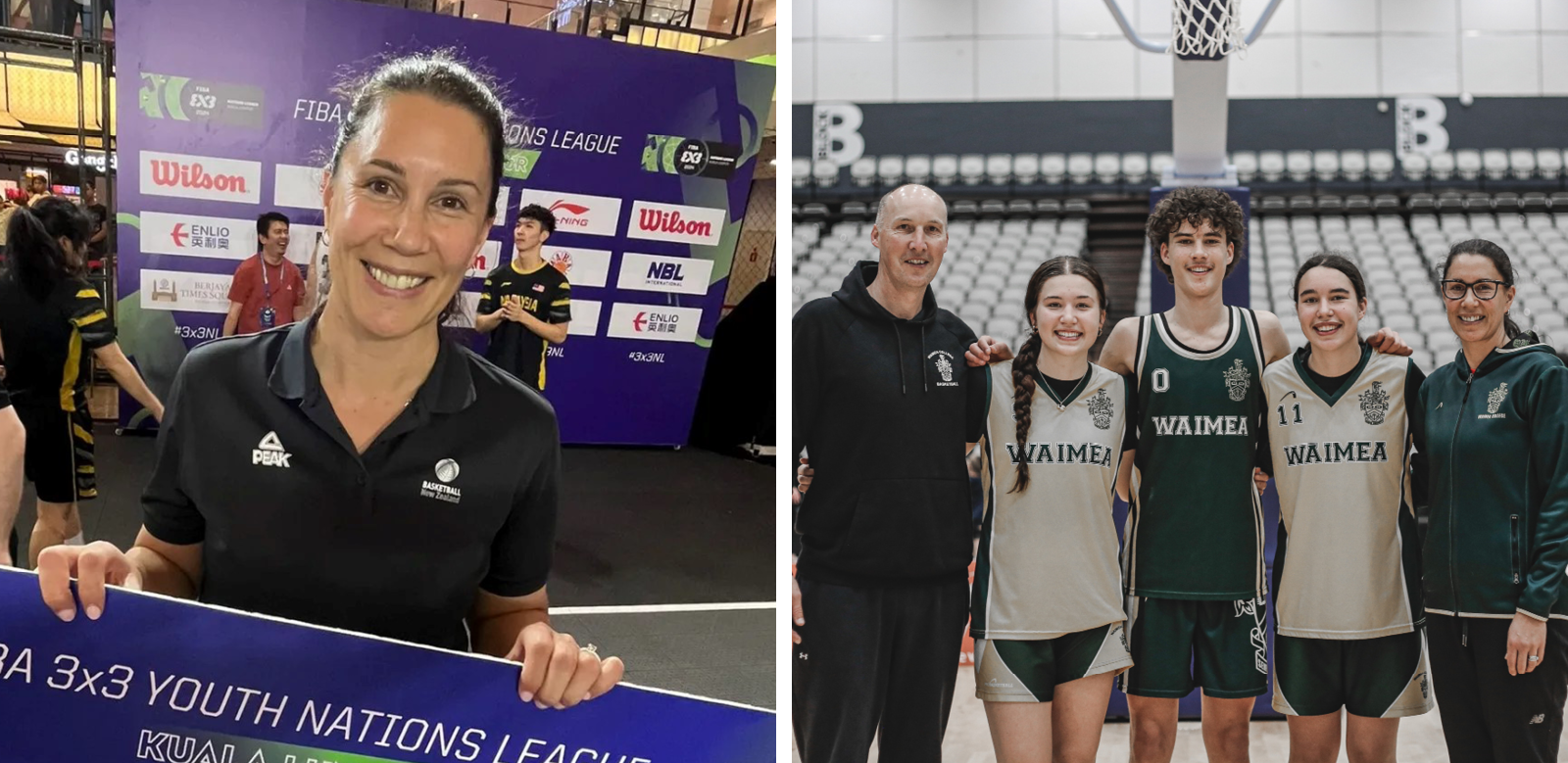
In 2012, Zizic told her good friend that she was going to stop coaching the Waimea College girls team and she thought Jones should replace her. In time, Jones would also go on to coach her children’s school sides, as well as representative teams for Nelson and the Tasman region. It was her way of giving back.
“I enjoy working with young people and coaching and teaching. I enjoy watching young people develop and develop their goals and dreams. I also think building resilience is a really key factor these days.
I know people talk about this all the time and a know there’s lots of different things coming at young people, but being resilient through sport is a really good way of learning that things don’t always go your way, life’s not fair, all of those little things that sometimes as parents we try to protect our children from, sport is the great equaliser. Just because your team is the best, it doesn’t necessarily mean your team is going to win at the end of the day and there’s lots of lessons to be taken from sport.”
Some years later, Jones was asked to apply to be the manager of the New Zealand U17 girls team. She was hired, with Tall Blacks legend Pero Cameron their coach. Although Covid scuppered plans for the side, she made an interesting connection Nikolay Mikhalchuk who was involved with the Basketball New Zealand’s junior programme.
After that Covid hiatus, Mikhalchuk’s colleague Anthony Corban got in touch and asked Jones if she’d like to be involved in 3×3. Mikhalchuk became the 3×3 high performance manager and Jones became the 3×3 Tall Ferns Manager. The following year she became the assistant coach, and also replaced U23 coach Justine Reed, as Reed was unable to go to the Asia Cup games in Singapore.
“I really enjoyed getting to know that version of the game which has been around for a while, but it’s growing and there’s a bigger understanding of what it involves now and I just love all the different elements about 3×3,” Jones says.
Jones observes that events such as the Paris Olympics have shown the world just how accessible 3×3 can be.
“You can hold it pretty much anywhere and it’s really engaging. The crowd is quite intimate as well because you’ve got a small halfcourt, so you can see and feel what’s going on.”
“Sometimes I think with a five on five game, you can be quite far removed depending on where you’re sitting, but with 3×3 you’re just in the action. It’s fast and even if you don’t quite understand what’s going on, there’s, not as many rules for people to understand.”
Jones has come to realise that as a coach, you really have to embrace having a lack of control and notes that’s even more the case in 3×3.
“You can prepare as well as you can but you can’t prepare for everything and sometimes there are things that happen on the court and you can’t call a time out or talk to the referees, you can’t talk to the players, so it’s about being aware and knowing that actually, I don’t have the control in the games, so everything that I need to do has to be done in the preparation and the trainings,”
“We have to be really secure in our systems. We can allow for a bit of flair and people can go a little bit off script, but you’ve got a shorter shot clock, you’ve got less time, you have to be really definitive with everything you do, but in saying that, I don’t want people to be robots so they still have to want to be out there just to play and people make mistakes and you don’t have time to dwell on those mistakes, so that next play kind of attitude is hyper important in 3×3.”
Jones acknowledges that different athletes will be able to absorb different amounts of information, but by and large, simplicity is vital when she is preparing her side.
“There are certain players that like a lot of information, but then there are certain players who it doesn’t help, they can’t filter it, so it’s best to keep it simple.”
“I think if you’re trying to figure out all the wrinkles the day before an event it’s too late, so that’s a big learning over the past couple of years. There’s our non-negotiables, this is our style of play, this is what we need to be restricting, this is what we need to be promoting. If I can get it down to five things, that’s a key thing over the past couple of years that’s really important.”
Looking ahead, Jones sees huge opportunities for the 3X3 game. Next year, there’s the Commonwealth Games in Glasgow, and then there’s the 2028 Olympics in Los Angeles, as well as a more local opportunity in the Brisbane Games four years later.
“I still really enjoy five on five, but I see 3×3 as another opportunity for New Zealand basketball to get to the world stage. The Commonwealth Games is a prime example. We’re one of 10 sports that have been chosen and selected so that’s a really important opportunity that we would love to be at.”
QUICK FIRE Q&A
Why did you get into coaching?
As a way of giving back to the sport that’s given me so much. I enjoy watching others improve and seeing that lightbulb moment when you can see they’ve got something and they’re using it to help them improve.
Who inspired/inspires you as a coach and why?
My family, from my husband to my oldest, middle and youngest, watching their achievements and being a small part of them, that’s a special privilege. Also my friend Tatjana Zizic. She led by example as a player and as a coach. I respected her as a coach because she had high expectations and always believed in me and had trust in her players.
What has been your biggest learning as a coach?
Knowing that you have no control. You have influence, you can prepare athletes for different scenarios, but at the end of the day, athletes will make the decisions and you need to trust and support them to make those decisions.
What are you most proud of as a coach?
Helping to develop young people and encouraging their character. Building resilience and supporting them to achieve their goals.
What is the biggest challenge you have had as a coach?
I had some quite challenging behaviours from a couple of young players and also their parents. At the time I wasn’t great at setting boundaries around behaviour and conduct and I needed to be more assertive around those things.
How do you want to be remembered as a coach?
Someone who maintained good relationships, someone who was prepared and also someone who got the best out of her athletes.
QUICK FIRE Q&A
Why did you get into coaching?
I got into coaching after enjoying my learn to swim teaching and also because I was so lucky to have great coaches all along my athlete path. I felt that once I started, because I was able to gain so much great knowledge from those who supported me that I should pass it on and give back to both the sports I enjoyed.
Who inspired/inspires you as a coach and why?
All of my previous coaches and the athletes and coaches I now get to work with. I’m very lucky in my position now with the calibre of support around me. Frank Tourelle, my Lower Hutt swim coach, as well as Scott Bartlett and Jason Pocock, my New Zealand team coaches, were huge for me.
What has been your biggest learning as a coach?
In my club coaching days it was to leave my personal life at the door and enjoy working with kids and enjoy their time working hard. Then the gains that are made together are even better. Since being in my high-performance coaching role, it’s to listen to all members of the teams I’m involved with, but ultimately sometimes trust myself as well and make the decisions that I feel need to be made.
What are you most proud of as a coach?
I am really proud of the resilience our New Zealand teams showed in the past two years. Things went wrong and decisions went against our strategy but to see them carry on and fight, it was great to be a part of that culture and lead it. I am loving the mana and pride our team is bringing to each other.
What is the biggest challenge you have had as a coach?
My biggest challenge was definitely moving from being an athlete and teammate with our current athletes, into leading them in the coaching role. Finding the balance and keeping honest and open communication lines wasn’t always easy. That’s something that will always keep challenging coaches.
How do you want to be remembered as a coach?
As someone who cared for the athletes, coaches and staff I worked and someone who enjoyed it. I always think back to a time in 2014 where the Black Fins got to sit in a room and hear from Steve Hansen. He talked about how the All Blacks want to leave the jersey in a better place than they found it. I try to take that same mentality to my high-performance coaching role as I am a caretaker of that role. I want to make it better not only for the athletes I have now but for the whole programme in the future.