Emma Millar
Emma Millar
- Coach Profile
One morning, Emma Millar will be coaching Commonwealth Games gold medallist Joelle King. In the afternoon, she’ll run Racket Rascals, a programme for two to four-year olds. When the evening hits, she might be teaching an adult how to hold a squash racket for the very first time, or a teenager who’s aiming to represent New Zealand.
It’s the love of the sport, and the love of coaching that keeps Millar, a former top player herself, so active in all areas of the coaching space.
Growing up in Paraparaumu, Millar’s dad played squash and was active in the local club, so her and her brother grew up around a squash court, and started playing young.
The sport gave her opportunities her peers weren’t receiving, and that was a perk to stay in squash when she was younger.
“I got the opportunity to go to Australia when I was 12 to play in a few junior tournaments over there, while my netball mates were getting trips to go to Palmerston North to play netball,” Millar explains.
“So it was quite an easy choice to pick squash as my number one, when we were getting to travel over to Australia, and the other sport is travelling an hour or so up the road,” she laughs.
Informal coaching started while she was still at school, but Millar never expected it to become a professional pathway for her. Studying sport and leisure studies alongside management studies at the University of Waikato, Millar avoided teaching and coaching papers – convinced that wasn’t in the cards for her.
But needing a part-time job to support her through uni, coaching squash was a convenient way to do that, Millar already on the court sharing her knowledge, and then picking up formal, paid roles.
“And generally getting paid more than your mates who were flipping burgers at Maccas, or serving drinks on a Thursday night at the Outback,” she laughs.
“It was something that I enjoyed, but I never saw it as a pathway. It was something that helped me pay my way through uni.”
Unable to see herself working in the corporate world, stuck behind a desk, Millar moved into teaching, working at a primary school alongside coaching, while still playing at a high level.
In 2016, Millar was playing with the New Zealand national women’s team, and suffered a bad concussion.
“In that time, I was told I’d never play squash again, not to the level that I had been playing at,” Millar says, the news devastating her dreams of playing at a Commonwealth Games one day.
Working with ACC concussion specialists, psychologist, neurologists, occupational therapists, she struggled to get back even courtside to squash, months after the concussion.
“I went to watch a few sessions and I couldn’t follow or track the squash ball on a squash court – just the contrast between the black ball and the white walls,” she explains.
“So I was like well I’m probably not even going to be able to coach. My world got flipped upside down a little bit.”
Millar returned to teaching in 2017, accepting a full-time position with the understanding that her squash dreams were temporarily out of reach. But she kept working, determined to not only return to coaching, but playing too.
Fast forward to 2020, Millar won a national title, and also began to realise where coaching could take her. Through Shelley Kitchen, an ex-player, and Squash New Zealand, Millar was given the opportunity to coach the NZ junior girls.
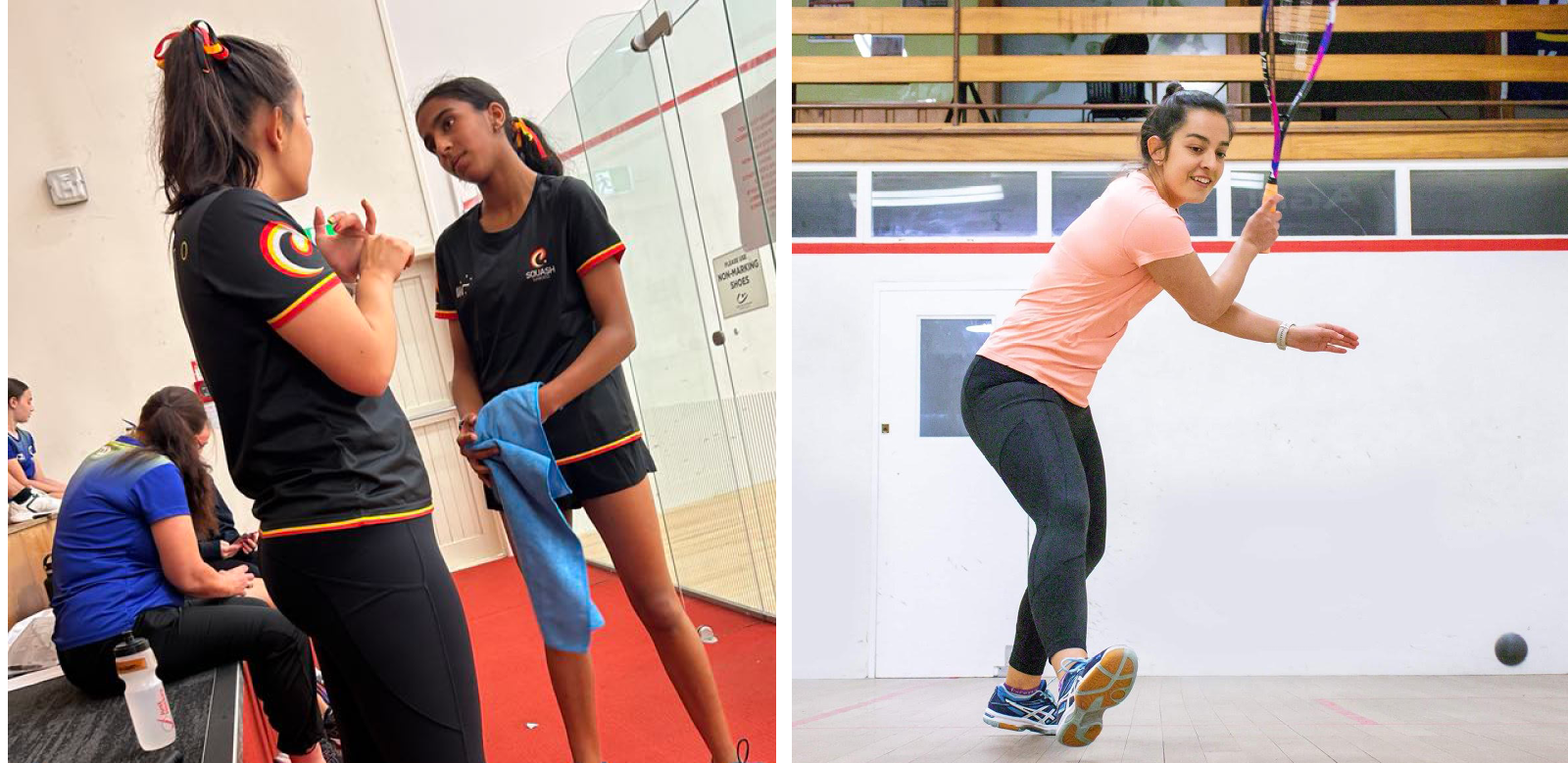
“That was an incredible opportunity really, and it was like this is where I want to be,” she says.
“That kickstarted my desire to want to work in pre-high performance coaching in New Zealand.”
In 2021, Millar left her full-time teaching job, wanting to be able to give 100 percent to squash. While her dreams may have evolved, Millar is still aiming high in the squash world.
“One of my goals when I got into high performance coaching was to be the first female squash coach to go with the New Zealand team,” she says, referring to the Commonwealth Games. With the 2026 Commonwealth Games running a reduced schedule, squash is one of the sports left off the list, a devastating decision for the sport.
“It could be tough going post-that for our country, we really need it to be a Commonwealth sport. From a New Zealand perspective, from a funding point of view, for our performance pathways,” Millar says of its exclusion.
Squash will be included in the 2028 Los Angeles Olympic Games, but only singles, with less qualification spots than the Commonwealth Games had for athletes. It’ll be a tougher ask, but Millar is still determined to coach at a pinnacle event.
“We’ve had such a rich history but we’ve never had a female coach go with the New Zealand teams. Things like that, someone’s got to be the first,” she says.
“The Olympics, if we’ve got athletes who are competing there, that now becomes a goal. There’s so many firsts that you think in New Zealand should have happened.”
Millar is currently involved with the national programme, having particularly worked in the girls’ space. She knows from first-hand experience how having a female coach can be a game changer for young girls in squash.
“In squash, we’ve never had a national female coach, we’ve always had males, and for as long as I have been involved, they’ve always been internationals. While we’ve had a rich history of female squash players performing, we’ve generally had male coaches,” Millar explains.
Kylie Lindsay, a former professional player, competing in two Commonwealth Games, was Millar’s first female coach, an experience that inspired Millar.
“The difference in that relationship, it was a game-changer. She knew more about the female game, and how we as females operate than any male could,” says Miller.
To boost her knowledge and support system as a woman in coaching, Millar was selected to be part of the Te Hāpaitanga programme – an 18-month long initiative that supports women pursuing high performance coaching.
“Just to be with like-minded people who more or less have all overcome similar challenges and faced the same challenges, same barriers is very cool,” Millar says of her experience so far.
“It’s very cool to get opportunities like Te Hāpaitanga, where you are able to, that are women-specific spaces because it definitely doesn’t happen in our sport very often.”
Millar also works as a development officer for Squash Waikato – the only woman to hold that role in a district in NZ.
“The increase in female participation, both juniors and even in our coaching personnel, the number of females we’ve got in there is probably higher than anywhere else,” Millar says of the Waikato region.
“We can say it’s because there’s a female coach involved, there’s nothing to back that, but I think across sports, it seems to be the general trend.
For a year now, Millar has been working with Joelle King, the top-ranked women’s squash player in New Zealand. King has won eight Commonwealth Games medals, five of which are gold, and reached the semi-finals of the world champs in 2023.
“Working with Joey [King] on an individual level has been an incredible experience, probably one of the more interesting parts of my journey,” says Millar, who’s three years younger than King and always looked up to her as a junior.
“That’s been a really cool relationship to navigate, learning more from her and being challenged in different ways as a coach, thinking outside of the box a little bit more.
“You’re not out there to see what other coaches have done and try that with her, you’ve got to forge your own path and see where it goes, and take a few risks, some will pay off, some won’t – and have a bit of fun along the way.”
It’s an experience Millar didn’t expect to have, particularly so early in her coaching career, but it’s solidified what she knows she wants to do – coaching. Whether it’s working with one of the world’s best, or teaching someone how to hit the ball, it’s all about enjoyment for Millar.
“At the end of the day, for me, if I’m enjoying what I’m doing, they’re going to enjoy what they’re doing and vice versa,” she says.
“That element of enjoyment, or fun, and what fun looks like for different people is obviously slightly different, but I think that level of energy has to be there.”