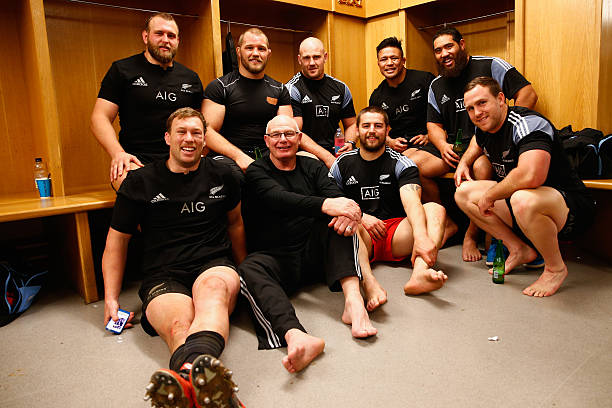
Mike Cron
Mike Cron
- Coach Profile
A mastermind behind the intricacies of what determines a successful rugby scrum, Mike Cron has achieved legendary status, and nearly 40 years on remains in hot demand for his coaching expertise around the world.
A rarity in the uncertain world of sport’s coaching, Cron has never had to worry about job security since swapping from his original career of choice as a police detective to fulltime paid coach, having never applied for a rugby job or having gone through an interview process.
Coaching extensively across the amateur and professional divide, the mild-mannered Cantabrian has been hailed for his visionary approach to coaching techniques. In the process he has cemented his global status while leaving an unrivalled imprint on all corners of the rugby globe.
Cron’s changes to standard scrummaging procedures by combining biomechanics for understanding body movement, ballet inspiration for grace and agility and martial arts skills for strength and precision, marked a new era in how the scrum was addressed and how the game of rugby was played.
He has also become renowned for his work on scrum safety, for which he was made a Member of the New Zealand Order of Merit (NZOM) in 2015.
In a defining career, which includes a remarkable 16-year stint with the All Blacks (2004 -2020), spanning four Rugby World Cups, and two title wins in 2011 and 2015, Cron added another World Cup title with the Black Ferns in 2022, but in his under-stated way, it is the coaching per-se that remains front and centre.
A coach’s coach, Cron gets just as much satisfaction out of coaching an amateur group of players as he does a top-ranked international forward pack and very rarely says no to anyone.
“When I was with the All Blacks, at the end of every year you had a review and I always got the same feedback, which was, `you’ve got to learn to say no to going around helping people because we need you to be fresh when you come back into the All Blacks,’’ he said.
“And Sir Graham Henry (former All Blacks coach) said I had to listen to that advice. So, I said, well you tell an amateur club when they ring you, no. I said I would find that very difficult, I would find it easier to say no to a professional coach who had asked. I could never say no to an amateur coach because I had been there for so many years and I understand it, and would never say no to an amateur gig, to go out and help.’’

Turning 70 this year, Cron is showing no signs of slowing down, the rise in video conference technology meaning he is fielding an on-going stream of requests from around the world for his knowledge and expertise while highlighting the esteem in which he is held, and his status as the “scrum doctor’’.
And it all started at a very young age when he mixed playing and coaching roles with his everyday job as a detective.
That was during the 1970s when things were vastly different.
Captain of the New Zealand U21 (Colts) team in both 1974-5, under coach Jack Gleeson, who went on to become the All Blacks coach, Cron was thrown in at the deep end.
“We only had the one coach, Jack Gleeson, who was the head coach and he said, `I’ll run the team and coach the backs and you run the forwards’, so at a very young age, I was chucked into that and then the following year I was eligible again, captain again, and again we did the same system and it all sort of started there,’’ Cron said of his introduction to coaching.
Still playing senior club rugby in Christchurch, Cron dabbled in a little coaching and got his first fulltime assignment as the forwards coach of St Andrews College first 15. Coaching fulltime since 1983, Cron served a long apprenticeship in the amateur ranks to hone his craft while continuing his paid career as a detective.
“I enjoyed doing it and I don’t know if I felt I had any talent at all to be honest,’’ he said.
“When I went coaching I knew two things: I wanted to help the players enjoy their time playing whatever sport it was and in this case it was rugby, and the other thing was I knew I didn’t have enough knowledge to be a coach and I had to go out and obtain knowledge to develop.
“Most nights or every second night you’d be asked to go and help clubs, schools, referees’ clinics, anything like that, and when I look back it was probably 18-19 years of amateur apprenticeship.
“Occasionally, if you had to travel big distances, you might have got a $10 petrol voucher or a bag of spuds. That’s what it was like in those days and that was great. You didn’t expect anything, it was nice to be asked, and off you went.
“I ended up coaching a hell of a lot of different age groups, different clubs, different schools and helping referees, so it was a good cross-section.’’
Being invited by future All Blacks coach Steve Hansen to help him out with the forwards in the 1998 Canterbury NPC team provided the first steps towards a professional career in rugby’s paid ranks and transitioning out of the police.
When Hansen got a similar role as the Crusaders forwards coach, Cron was again on hand to help out. Things quickly changed when Hansen was appointed head coach of Wales where he became a revered figure.
Helping a friend who was coaching in Japan in the early 2000s and joining Hansen in Wales in 2003, Cron’s professional coaching career was gathering momentum. He was also the New Zealand Resource Coach, paid by the NZ Rugby Union, which involved travelling the country, and going into all the (Super) franchises, all the NPC teams, some schools and helping with sevens rugby, culminating in 2004 when he was asked to go fulltime with the All Blacks.
“One thing just led to another. It was all a bit bizarre really and something I haven’t thought too deeply about in how it’s all panned out,’’ Cron reflected.
“Someone quite recently was asking me about CVs. I remember getting a CV done once and my wife organised me to go into a company that typed it up for me (on a typewriter), so I did have one but I never used it. That’s a long, long time ago and I’ve never actually had a job interview for rugby, and never applied for anything, really.’’
Once finishing with the All Blacks, there was no sitting back twiddling his thumbs and ruminating on what might come next, instead the demand for his services was immediate with a varied range of opportunities popping up on a consistent basis.
“I finished, officially, in March 2020 with the All Blacks and that was the end of a long old haul, 16 years. My time was certainly up and I didn’t really know what I was going to do,’’ Cron said.
“I set up a little company, Mike Cron Coaching Ltd, to run zoom meetings and help coaches and I still do that around the world or wherever. Some players also get hold of me. That’s a business and it’s great to meet people from all walks of life, and that’s interesting for me.’’
Once that was up and running, Cron got involved with helping World Rugby, which was being run by former All Blacks attack coach Joe Schmidt at the time, seeking his input for World Rugby’s referees with an emphasis on their decision-making at set piece.
“I did about three years working for them, most of it from home, analysing games, writing notes about referee’s decisions etc, and then I ended up doing the same for the Japan top league and the MLR (Major League Rugby) in America,’’ Cron said.
“So, I did a lot of that stuff, analysing. When you’re analysing, you look at stuff two or three times, so I’d be looking at over 1000 lineouts and scrums every weekend on the computer and then writing a quick little summary of each one, which took about three days every week.
“And while you’re not out on the grass with a whistle around your neck, as such, what that does is you get a really sharp eye for detail.
“That’s the first thing that goes as a coach, is your eye, and that helped me keep my eye even sharper, so when I see something I know straight away if it doesn’t look right and can look into it. So, even though I wasn’t out on the field as much, that helped me.’’
Cron was then approached, along with former All Blacks coach Wayne Smith, to help prepare the Black Ferns for the 2022 (women’s) World Cup being stage in Auckland. It proved an exhilarating ride when coaching women fulltime for the first time in a winning campaign that captured the heart of the nation.
He was also back with the All Blacks for one test, against Ireland in 2022 when three All Blacks coaches went down with Covid.
“That was interesting. I came back in for that one week, did the All Blacks and then ducked out again, did the Black Ferns, ducked out of that and then went to the World Cup in 2023 with World Rugby and the referees’ side of things,’’ Cron said.
“And then in 2024, I thought, well, that’s it. I’ll just relax and sit back a wee bit. Then Steve Hansen rang to see if I could give him a wee hand over at Toyota (Japan) where he coaches with Ian Foster, so I’ve been mentoring a couple of coaches there.
“And then (coach) Joe Schmidt rang to see if I’d give him a hand with the Wallabies, so all that’s happened. It was only supposed to be a short-term gig to make them competitive for this year’s British & Irish Lions series and then we were going to finish, get out and hand it over to Aussie coaches.
“That was the plan. But we both agreed to stay on for the Rugby Championship with me finishing after final test match in Perth.’’
For the next little while, Cron is going to work in the background helping Australian rugby develop a youth tight five structure, most of which he can do from home. He hopes to build the momentum for the next crop of tight forwards in Australia, get a conveyer belt underway and then hand it over to Australian coaches to keep it up and running.
In a career which has delivered a multitude of highlights, the 2013 Rugby Championship decider between the All Blacks and South Africa at Ellis Park in Johannesburg stands out as Cron’s most memorable moment.
In a pulsating free-flowing clash, the All Blacks prevailed 38-27 in a nine-try spectacle during which the lead changed hands eight times.
“That is the best game of rugby that I’ve ever been associated with, as far as both teams playing unbelievably good rugby, Nigel Owens refereeing and just letting it go,’’ Cron said. “It was just a magnificent game of rugby and I walked away thinking I’d never seen anything like that, probably never will again and I was just lucky enough to be there.
“That’s a real highlight because as a purist, that was the purist game of rugby I’ve ever seen.’’
For Cron, who never in his wildest dreams ever imagined his career would pan out the way it has, the what, the why and the how provide the formula to becoming a successful coach.
“That means what are we going to coach, why are we doing it, then the how. I think the what and the why are pretty easy to convey to your athletes, the how is where you get your world-class coaches, your good coaches,’’ he said.
“We’ve all got the same information, how do you convey that information where your athlete gets deep understanding, and that’s the key, deep understanding.
“I’ve been in lots of environments, but as a coach, the only advice I would say is the first thing you have to set up is a safe learning environment, for both physical and psychological safety. That will help them grow.
“The next thing I would encourage to set a standard is that the best coach in your environment is the person you’re actually doing an activity or a skill drill with. At that moment he is the best coach for you.
“So, if there’s two of you doing a little drill, each other are your best coaches. If you can drive that in an environment, it really lifts the bar collectively, across the whole lot because one coach or two coaches can only see so much. But by having pair coaching and getting them to buy into that and drive that, you’ll get advancement very, very quickly.
“And the third thing I would say, is never allow mediocrity. If you’re going to put your boots on and walk across the white line for training, there’s no place for mediocrity. I’d rather you not come to training. So, if you’re going to go out there, lets try and get better.
“We always say you want to be better today than yesterday but you have to have a drive to do that, so if you have that strong learning environment, safe learning environment, you’ve got your pair coaching going and you have no mediocrity, very quickly you get really huge development.’’