Mike Rodger
Mike Rodger
- Coach Profile
A casual arrangement with champion single sculler Rob Waddell 18 years ago was enough to change the career path of Mike Rodger and with it, a celebrated climb to becoming one of New Zealand’s premier rowing coaches.
As an elite level athlete, Rodger won a silver medal in the lightweight men’s double sculls at the 1994 World Rowing Championships and represented New Zealand at the 1996 Olympic Games in Atlanta before hanging up his oars.
In more recent times, he has continued to fashion a stellar coaching career as one of the most decorated coaches in New Zealand rowing history where he has been on hand for four Olympic medals, seven World Championship medals and more than 20 World Cup medals.
Wanting to give back to the sport, Rodger got involved in coaching immediately after finishing his competitive career by mentoring school and junior crews before moving on to the premier group at Waikato Rowing Club but, that, initially, was not his intended career path.
“I actually stopped coaching in 2000 as I had a young family and a business and did nothing again until 2008,’’ Rodger said.
“I literally came back in 2008 on the basis of coming to town occasionally to give Rob Waddell a hand which turned from a casual arrangement into a pretty serious return to coaching, which to be fair, I really enjoyed, so I blame him for getting back into it and getting fully immersed in the sport again.
“It started off pretty casually, just a few of times here and there but, essentially, he got me back into it. At the time, I was coaching a Cambridge High School crew with him and then it sort of snowballed from there.’’
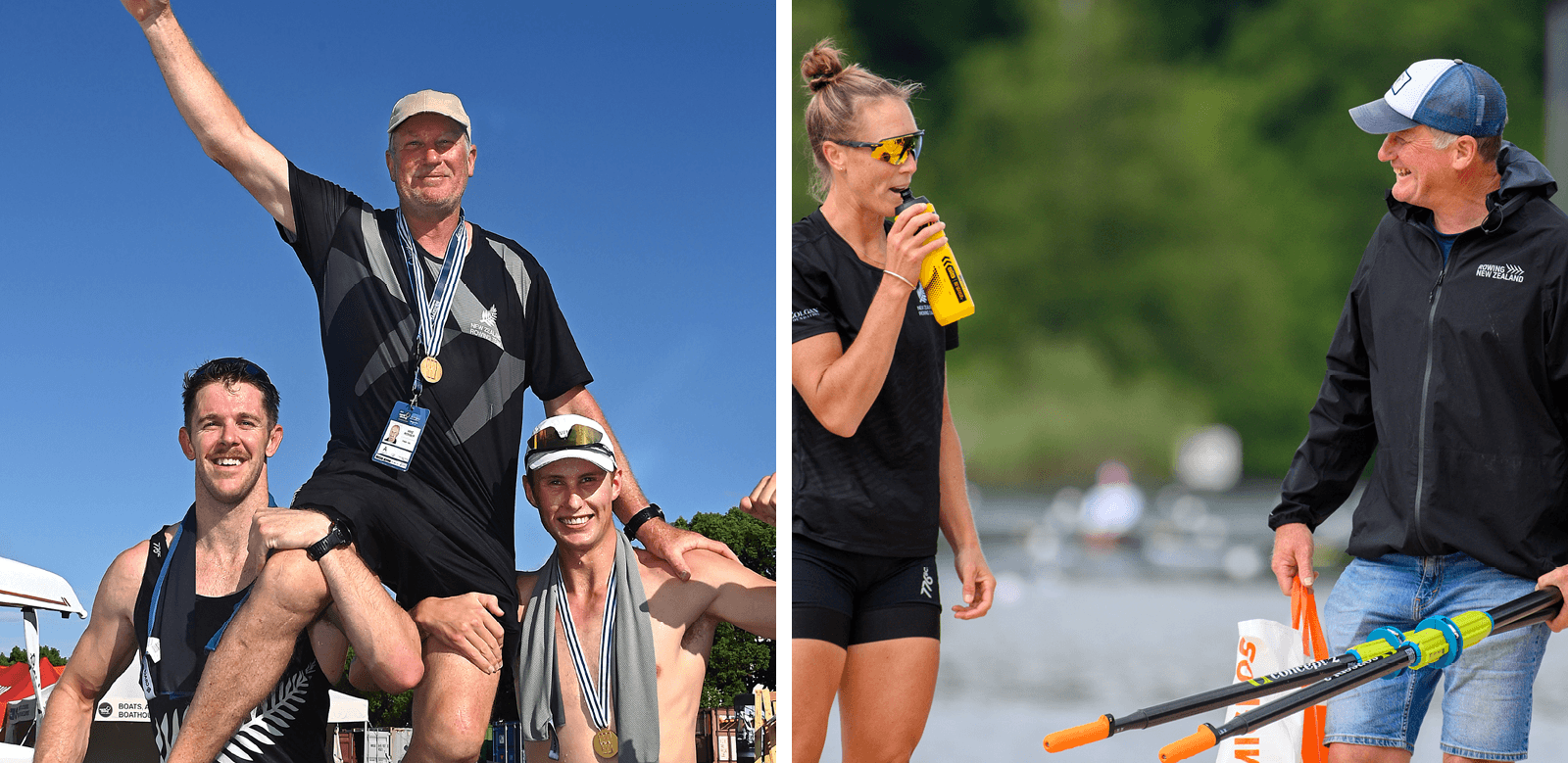
After several years away when he became a grinder for Team New Zealand during the 2002-03 and 2007 America’s Cup campaigns, Waddell, a two-time World Champion (1998 and 1999) and 2000 Sydney Olympic single sculls gold medallist, was eyeing a return to elite-level rowing and enlisted Rodger’s help in a bid to gain selection for the 2008 Beijing Olympics. He was subsequently chosen as part of the double scull crew.
That coincided with Rodger being employed by Rowing New Zealand as a Regional Performance Coach for a couple of years and in 2010 working for the first time with an elite crew.
“I started coaching sculling….I was a sculler myself. I went away in both rowing boats and sculling boats but I guess my greatest success was in sculling as an athlete. So, sculling was my initial call into coaching and probably as much because of Rob (Waddell),’’ he said.
“So, I did several years of coaching scullers in multiple boats – singles, doubles and quads with mixed successes.’’
Another similarly-prominent single sculler to come out of retirement, for a second time, and seek help from Rodger was the great Emma Twigg.
After three Olympic campaigns, Twigg had retired following two heart-breaking fourth-place finishes at the 2012 London Olympics and following Rio Games in 2016. Under Rodger’s watch, Twigg roared back in decisive style, clinching the gold medal at the 2021 Tokyo Olympics to the universal joy of the nation while securing the silver medal in Paris, 2024, to close out her decorated and storied career across five Olympic campaigns.
“In 2018 Emma Twigg asked me to coach her and from there it rolled on pretty successfully,’’ an understated Rodger said.
“At that time, I was also coaching a women’s pair and a women’s double.
“I’m not sure why I ended up doing all the multiple boats but I actually really enjoy that side of it. It means you can switch off from one boat. A lot of coaches in our sport enjoy having multiple boats of similar speeds so they can coach them all the time, but I really like the fact that they were such different speeds that when I was with one, I couldn’t look at the other boat. They were completely different training sessions.
“So, I just enjoyed having the different speed boats because it meant you just couldn’t sit there and be complacent because you have to think and get your eye in to the different speeds of boats and things like that. I just find that part really enjoyable.’’
Enjoying the challenge of coaching multiple boats, Rodger also juggles female and male athletes, describing his approach as the “same but different.’’
“The technical model is similar and what you’re trying to do,’’ he said. “With the physicality, I think sometimes females can row a bit nicer because they’re not so physical.
“A male obviously generally has longer levers and quite a bit more power to add to the boat, so they can look quite different, but again the principles of rule are very similar.
“In Paris (Olympics) it was a bit of a challenge. I had a men’s four and Emma (Twigg), and going from a very fast male boat to a woman’s single sculler which is probably both ends of the spectrum speed-wise, it took a while to get your eye in but, again, I think that probably has made me a better coach for doing it.’’
Rowing is entrenched in New Zealand’s sporting DNA, having created an outstanding legacy of success for a country so small and so far away from the sport’s traditional hubs, and to which Rodger has added his own special imprint. He puts the on-going success down to a long line of great coaches and very good athletes who have laid the groundwork of succession which has inspired others to be great rowers. And, there’s one other important ingredient.
“I think one of the biggest assets we have is Lake Karapiro (near Cambridge) as a training venue. Internationally, it’s one of our key advantages,’’ he said.
And Rodger has certainly been inspired by those who came before, particularly the legendary figures of Harry Mahon, who coached with great success around the world and Sam Le Compte, who made a big impact in both New Zealand and Australia.
“Your basics of coaching come from the people who coached you, so I quite often find myself thinking `where did I get those words from’ then remember that’s what Sam or Harry used to say all the time,’’ he said.
“I was pretty lucky in my rowing career that I was coached by Harry Mahon and Sam Le Compte. I had some pretty good people around me and multiple others, which as a coach, I have picked little bits out of.
“And there’s been some coaches more recently……I quite often quote a guy, John Robinson, who was one of the elite coaches when I first came into the elite programme. He said some things to me which have stuck right the way through and I think have shaped how I coach nowadays.’’
For Rodger, success is measured in the moment and particular circumstances surrounding the outcome and it doesn’t always come on the biggest of stages.
“It depends what your goal is,’’ he said. “In some of those earlier days, getting crews that were perhaps bottom in the rankings and getting them to progress was, sometimes, as exciting and as good an outcome as watching Emma win an Olympic final or the men’s four getting their (Olympic) silver medal.
“But if I was to pin one out it would probably have to be, arguably, Emma’s silver in Paris (2024 Olympics). We had a few little hurdles where we were being challenged a lot of the time and for her to achieve what she did, was one of the highlights of what we did together.’’
The evolution of new athletes is a constant in the progression of sport and Rodger is excited about the prospect of working with a relatively new group of emerging talent at Rowing New Zealand and developing a few new boats around these athletes.
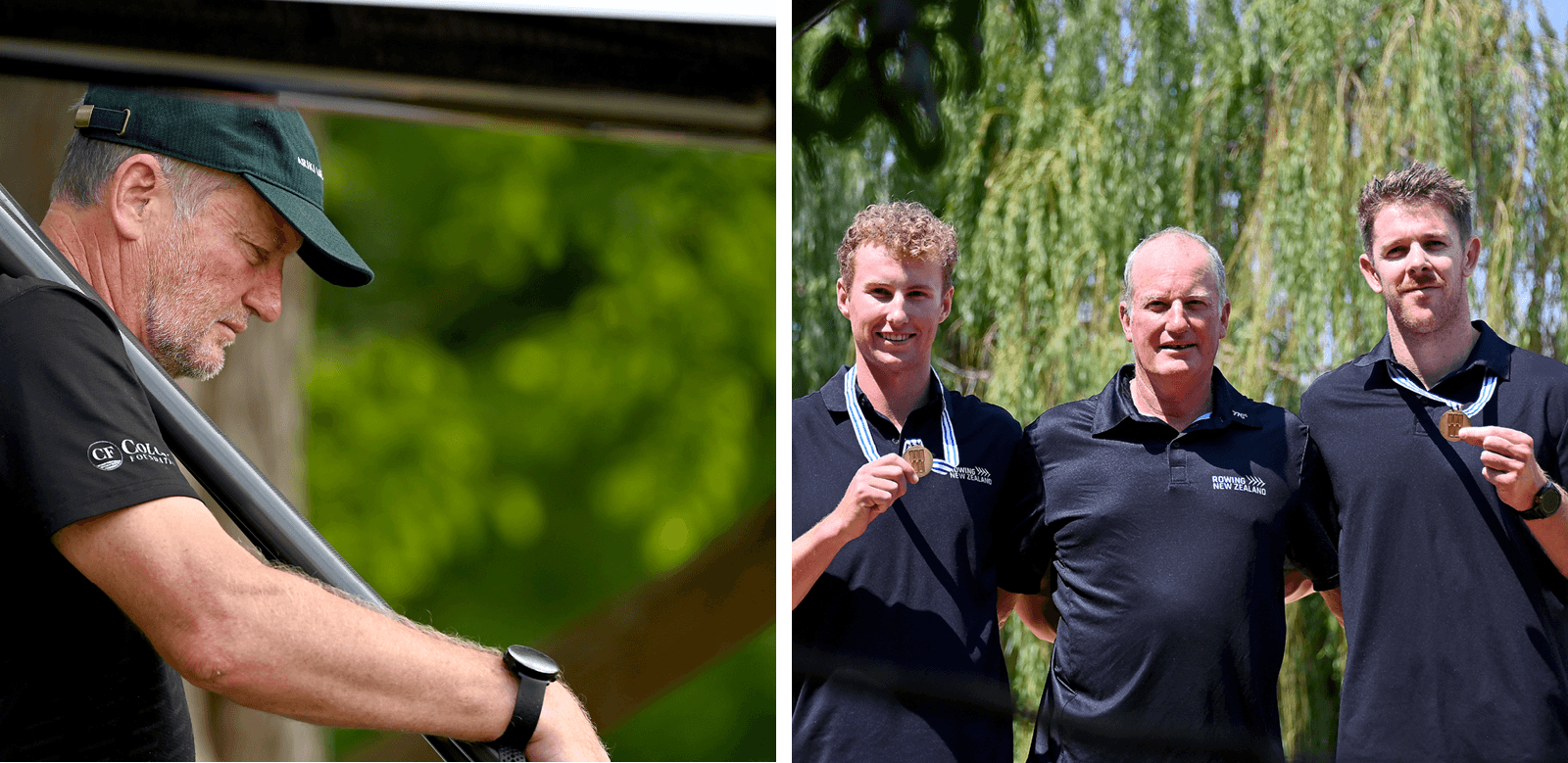
“You talk about highlights of a career and Olympic medals are great, but actually that men’s pair last year (Ben Taylor and Oli Welch) was a crew where I had fully been a part of their development from day one,’’ Rodger said.
“When you get young athletes like that coming through and developing to where they are and win a world championship, that’s probably what we all aspire to.’’
Only coming together in the pair from the start of 2025, Taylor and Welch completed a remarkable year when winning the men’s pair at the World Rowing Championships in Shanghai following silver and gold medals at World Cup events in Switzerland and Italy.
“What we’ve got right now is a lot of other young athletes coming through that you just want to do the best by and try and assist them to get as far as they possibly can with the sport,’’ Rodger said.
“We’re all going to say we want to win medals but at the end of it, only so many people can, so it’s just about making them the best athletes, rowers, human beings that you possibly can. And that is definitely one of my goals that I try and go and do every day. It’s not all about rowing, it’s just actually trying to make good people as much as anything.
“Good people become great people in society which actually inspires them to be better themselves.’’
Rodger still has his own upholstery business which was his family lifeline before coaching rowers took centre stage. There’s not so much hands-on work upgrading furniture these days, the man behind the tools taking another set of skills to continue developing New Zealand’s rich rowing history.
For Rodger, it’s a patience game and there’s no secret formula to what makes a good coach.
“At the end of the day, we’re only as good as our athletes, and again, going back to the pair and why I’m so proud of what they did, it’s because you’re developing those athletes from a very long way out to become world champions,’’ he said.
“To be fair, it just takes patience and time. We all start coaching thinking we can change the world but, actually, it takes time to learn your trade.’’